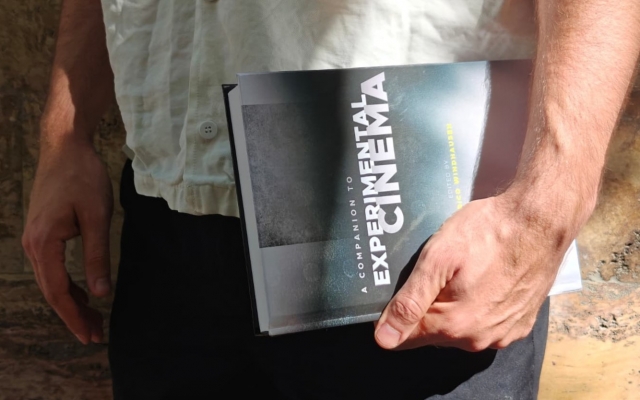
Book promotion: the Croatian edition of A Companion of Experimental Cinema
As part of the upcoming Festival’s program, we will present a Croatian translation of A Companion to Experimental Cinema, an instructive collection of essays edited by Federico Windhausen, a film historian, curator and a member of this year’s Grand Jury.
Working with experimental cinema occasionally means having to face the need to articulate, defend or elucidate what makes it relevant, fascinating and essential. This is the idea that serves as the starting point for Federico Windhausen in the essay collection aptly named A Companion to Experimental Cinema – its primary aim is to explore, in a clear and comprehensible manner, the position of experimental cinema throughout history, to this day. The book will be presented as part of the Festival, by Windhausen as the editor of the English edition, and the editors of the Croatian edition, Marina Kožul and Miro Frakić, on Saturday, September 26, at Studio Gallery Klet at 11.30 AM.
The Companion brings together texts by a variety of scholars who adopt diverse micro- and macroperspectives in their takes on specific experimental films and filmmakers, national cinemas, as well as the broader contextual frameworks. It consists of three parts, in accordance with their comprehensiveness: ‘Overviews’, ‘Case Studies’, and ‘Exchanges’.
‘Overviews’ includes texts that cover particular genres and categories that remain relevant, on a global and a more granulated level, in the history of audiovisual experiments, such as poetic cinema, expanded cinema, queer diaristic film and video, intermediality, found footage filmmaking, experimental animation, and soundscapes in experimental cinema; there are also investigations into the experimental, ‘underground’ scene in French and Spanish cinemas. ‘Case Studies’ comprise essays on specific films and visions of experimental luminaries such as Gregory J. Markopoulos, Michael Snow, Hijikata Tatsumi and Japanese experimental film/dance scene, Peter Kubelka, British formalists, and icons of feminist cinema, Narcisa Hirsch, Yvonne Rainer, Peggy Ahwesh and Barbara Hammer. The last section, ‘Exchanges’, includes conversations featuring a range of scholars, filmmakers (Deborah Stratman, Sky Hopinka, Naeem Mohaiemen, Sylvia Schedelbauer, Birgit Hein), critics and curators (Koyo Yamashita, Shanay Jhaveri, Erika Balsom) and other professionals; the thematic focus of these ‘exchanges’ is the position and impact of experimental cinema in the context of today’s film festivals and programming, as well as women’s and ethnographic cinemas in particular.
The essays were translated by Ema Brkljača, Petra Bušelić, Marija Ćaćić, Miro Frakić, Damjan Lalović, Marko Lucić, Željko Marčan i Erika Roša.
In Windhausen’s own words in the introduction to the Companion, this collection of essays “demonstrates how experimental cinema is continually being invented and defended, made and remade, repudiated and transformed, within a broader field of culture.” By combining lucid accounts with more academic takes on existing scholarship, the Companion offers innovative approaches to understanding, characterizing and interpreting experimental cinema.